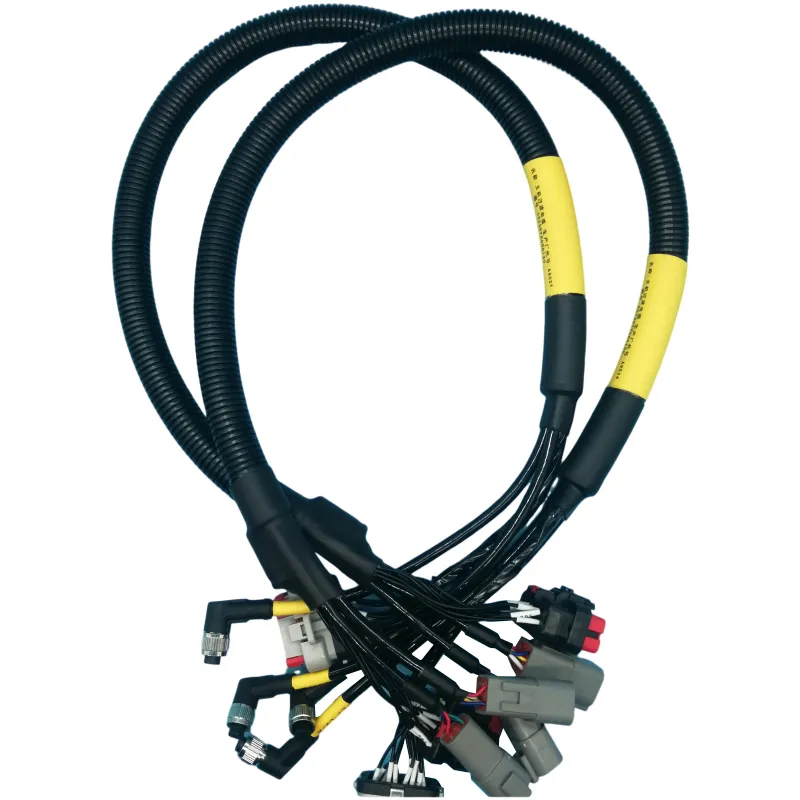
Cable carrier and e-chain harness builds
Drag Chain Cable Assembly
Built for cable carriers where bend radius, fill percentage, and jacket abrasion decide field life.
We engineer drag chain cable assembly for robot axes, linear actuators, gantries, AMR charging docks, and automation cells. Every RFQ gets a carrier-fit review before pricing.
Send a drawing, BOM, or sample
Engineering reviews motion and quote inputs before pricing.
Technical depth
Designed around the cable carrier, not just the connector list
A drag chain cable assembly must move freely inside the carrier while staying separated from pneumatic tubes, power lines, and data lines. We ask for the chain model or dimensions so the harness geometry matches the carrier from the first build.
Upload specs for DFMCarrier pairing
igus-style e-chain review
We review bend radius, chain width, separator layout, fill percentage, and bend direction before approving the cable stack.
Bend radius
Usually 7.5x to 10x cable OD
Small-radius builds require fine-strand conductors, a flexible shield design, and a jacket that does not crack or flatten in the carrier.
Jacket material
PUR preferred for harsh motion
PUR provides strong abrasion resistance and is commonly specified where carriers see oil mist, chips, coolant, or repeated sliding contact.
Flex-life data
Sample-tested to target cycles
We can test at the actual radius and stroke instead of quoting only a generic cable family rating.
Engineering review
Bend radius, flex life, PUR jacket, and e-chain details are reviewed before quote
The goal is to catch moving-cable failure modes before the first sample: conductor fatigue, shield breakage, jacket abrasion, connector exit stress, and cable-carrier mismatch.
E-chain fill and separation
Power, feedback, Ethernet, pneumatic, and coax lines should not be packed as one rigid bundle. We lay out divider spacing and jacket choices to reduce abrasion and signal noise.
Jacket and outer diameter control
A smaller OD can improve carrier fit, but excessive compression raises conductor and shield stress. We balance OD, shielding, wall thickness, and abrasion life.
Motion-specific exits
The transition out of the chain is where many failures start. We size clamps, boots, overmolds, and bend relief around the exit angle and unsupported span.
Continuous-flex test data
Validation evidence for first-article and production release
RFQ inputs that improve quote accuracy
- Drawing, BOM, or sample photo
- Dynamic bend radius and axis of motion
- Cycle-life target and stroke length
- Cable carrier or dress-pack routing constraints
- Connector series, IP rating, shielding, and annual volume
Trust and release support
Built for buyers who need inspection evidence, not only a low unit price
We support prototype builds, validation samples, and production lots with the release evidence expected by robotics OEMs and regulated manufacturing teams.
IPC/WHMA-A-620 certified specialist on staff
A certified specialist supports cable and wire-harness workmanship criteria, inspection, and operator training.
ISO 9001:2015
Quality management system with incoming inspection, in-process controls, and lot traceability.
IATF 16949 automotive quality controls
PPAP, control plans, PFMEA, and capability checks available for automotive-fed robot programs.
RoHS / REACH support
Material declarations and SVHC review available for production release packages.
Common programs
Where this page fits
Use this page when the assembly moves on a robot, cable carrier, tool changer, or compact cobot route and the RFQ needs more than connector cross-reference work.
Related solutions
Explore related robotics cable solutions
Match the RFQ to the motion problem so engineering can review the right failure modes.
FAQ
Drag Chain Cable Assembly questions buyers ask before RFQ
What information do you need to quote a drag chain cable assembly?
Send the drawing or BOM plus the cable carrier model or dimensions, bend radius, stroke length, speed, cycle target, environment, connector details, and annual quantity. The carrier information is important because the same cable can perform differently in different chain layouts.
Can you help pair the cable with an igus-style e-chain?
Yes. We can review chain radius, separator layout, fill percentage, and bend direction against the proposed cable construction. We do not need the carrier brand to start, but the chain dimensions are very helpful.
Is PUR jacket always required for drag chain cable?
Not always, but PUR is a common first choice for drag-chain motion because it resists abrasion, oil, and coolant better than many PVC constructions. TPE, silicone, and other jackets may fit better for special temperature, washdown, or medical requirements.
Do you test drag chain cable assemblies before production release?
For validation builds, yes. We can run sample assemblies at the requested bend radius and stroke, then document cycle count, jacket condition, continuity, and post-test electrical results.
Send the drawing before the next design review
Engineering reviews bend radius, flex-life target, jacket selection, shielding, and connector release details before the quote is finalized.
Get quote in 24 hours