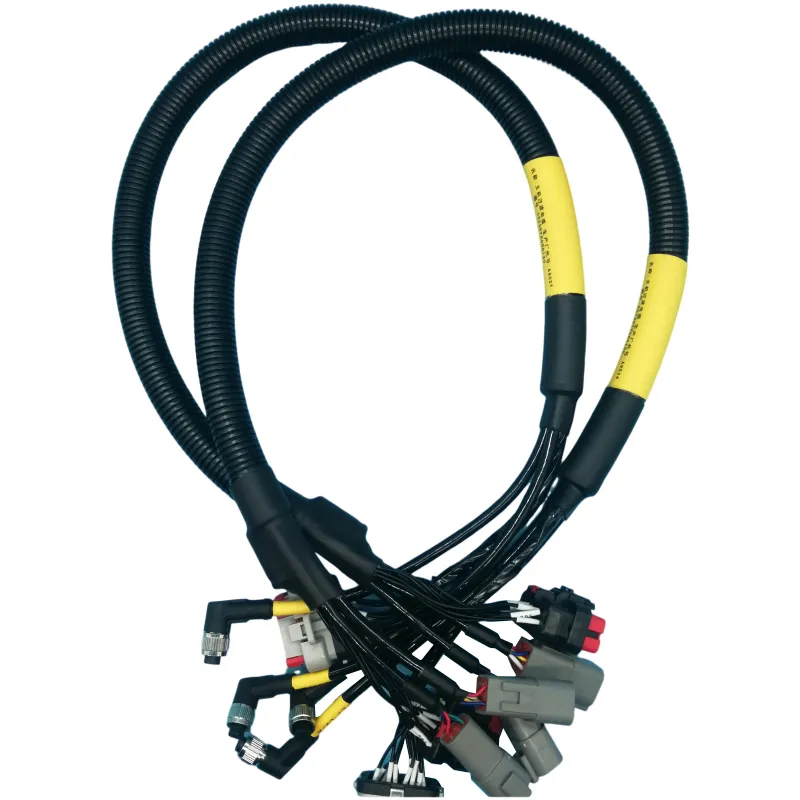
Robot cable assembly for OEM robotics programs
Robotic Cable Assembly Manufacturer
Custom robot cable assembly built for bend radius, flex life, shielding, and production release.
Send a drawing, BOM, or sample and a cable engineer reviews the motion profile before quoting. We build robot cable assembly for six-axis arms, cobots, AGV/AMR platforms, EOAT, servo power, encoder feedback, and industrial Ethernet.
Send a drawing, BOM, or sample
Engineering reviews motion and quote inputs before pricing.
Technical depth
A manufacturer for moving robot harnesses, not static panel cable
Robot cable assembly fails when static cable rules are applied to moving axes. We review conductor stranding, lay length, shielding, jacket durometer, strain relief, and carrier fill before quoting so the first sample reflects the actual robot motion.
Upload specs for DFMDynamic bend radius
7.5x to 12x cable OD typical
Final radius is set by conductor count, shield stack, jacket, speed, acceleration, and the cable carrier or robot wrist geometry.
Flex-life target
3M to 10M+ cycles
Bench plans can mirror the customer stroke length and bend radius instead of relying only on cable datasheet claims.
Jacket options
PUR, TPE, silicone, PVC
PUR is commonly selected for oil resistance, abrasion resistance, and tight cable-carrier routing.
Documentation
FAI, PPAP, test report
Crimp height, pull force, continuity, insulation resistance, polarity, and shield termination evidence can be packaged with the first shipment.
Engineering review
Bend radius, flex life, PUR jacket, and e-chain details are reviewed before quote
The goal is to catch moving-cable failure modes before the first sample: conductor fatigue, shield breakage, jacket abrasion, connector exit stress, and cable-carrier mismatch.
igus-style e-chain pairing
If the assembly runs inside a cable carrier, we check the carrier window, divider plan, fill percentage, minimum bend radius, and neutral-axis placement so the harness does not corkscrew or saw against neighboring lines.
Shield termination strategy
Encoder, EtherCAT, PROFINET, and servo feedback cables can use 360-degree backshell termination, drain-wire termination, or one-end grounding based on the cabinet grounding plan.
Strain relief that matches motion
Overmolded exits, heat-shrink boots, clamps, and tie-down spacing are selected around the axis that actually moves. Static strain relief is not enough for wrist and drag-chain routing.
Continuous-flex test data
Validation evidence for first-article and production release
RFQ inputs that improve quote accuracy
- Drawing, BOM, or sample photo
- Dynamic bend radius and axis of motion
- Cycle-life target and stroke length
- Cable carrier or dress-pack routing constraints
- Connector series, IP rating, shielding, and annual volume
Trust and release support
Built for buyers who need inspection evidence, not only a low unit price
We support prototype builds, validation samples, and production lots with the release evidence expected by robotics OEMs and regulated manufacturing teams.
IPC/WHMA-A-620 certified specialist on staff
A certified specialist supports cable and wire-harness workmanship criteria, inspection, and operator training.
ISO 9001:2015
Quality management system with incoming inspection, in-process controls, and lot traceability.
IATF 16949 automotive quality controls
PPAP, control plans, PFMEA, and capability checks available for automotive-fed robot programs.
RoHS / REACH support
Material declarations and SVHC review available for production release packages.
Common programs
Where this page fits
Use this page when the assembly moves on a robot, cable carrier, tool changer, or compact cobot route and the RFQ needs more than connector cross-reference work.
Related solutions
Explore related robotics cable solutions
Match the RFQ to the motion problem so engineering can review the right failure modes.
FAQ
Robotic Cable Assembly Manufacturer questions buyers ask before RFQ
What makes a robotic cable assembly different from a standard cable assembly?
A robotic cable assembly is designed around repeated motion. The conductor stranding, shield stack, jacket, bend radius, strain relief, and routing all need to support flexing or torsion. A standard static cable can pass continuity testing and still fail quickly on a moving robot axis.
Can you quote from an existing robot cable sample?
Yes. A sample, photo set, or marked-up drawing is enough to start. We still ask for motion details such as bend radius, stroke length, cycle target, and installation environment before releasing a production quote.
Do you follow IPC/WHMA-A-620 for robot cable assembly workmanship?
Yes. IPC/WHMA-A-620 is used for workmanship criteria, inspection, and operator training. Class level, documentation, and acceptance details are confirmed during RFQ review.
Can you supply test data for continuous-flex assemblies?
Yes. For validation builds we can provide a test plan with bend radius, stroke, cycle count, inspection photos, continuity results, and post-test electrical checks.
Send the drawing before the next design review
Engineering reviews bend radius, flex-life target, jacket selection, shielding, and connector release details before the quote is finalized.
Get quote in 24 hours