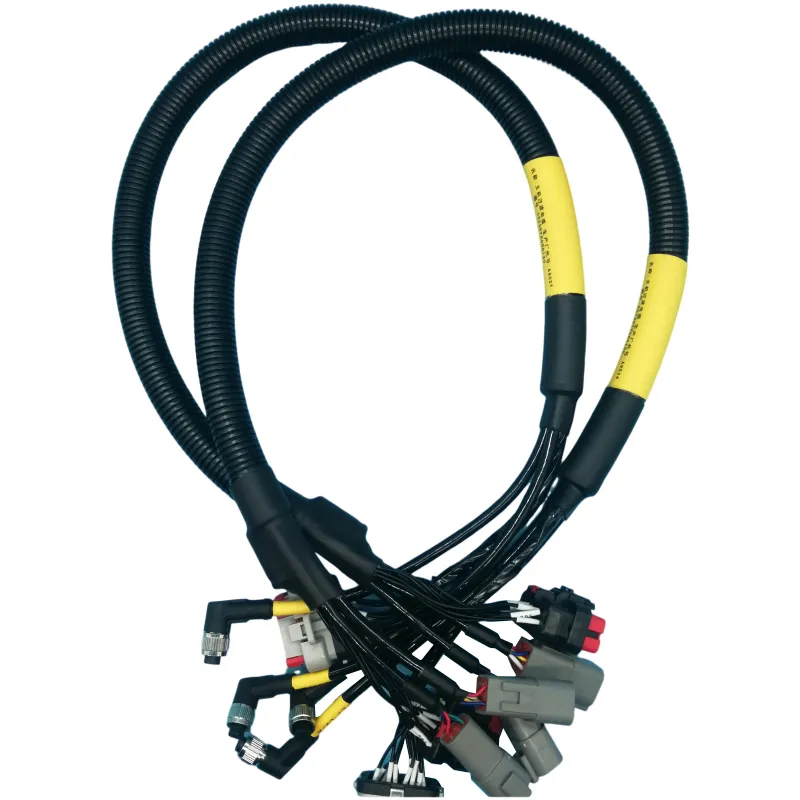
Robot dress pack cable and external harness routing
Six Axis Robot Dress Pack
Dress-pack cable assemblies built around wrist rotation, clamp spacing, EOAT changes, and field service.
We build robot dress pack cable sets for six-axis arms where external routing has to survive torsion, snag risk, tool changes, and repeated wrist motion. Send your arm model, EOAT layout, and cable list for engineering review.
Send a drawing, BOM, or sample
Engineering reviews motion and quote inputs before pricing.
Technical depth
External robot routing needs more than a bundle sleeve
A six axis robot dress pack has to move with the arm without fighting it. We review slack loops, clamp positions, unsupported spans, wrist rotation, tool offset, and replaceable segments before building samples.
Upload specs for DFMMotion review
Axis 4, 5, and 6 focus
Wrist motion usually creates the highest torsion and bend stress, especially near EOAT and tool-changer interfaces.
Cable jacket
PUR and specialty jackets
PUR is common for abrasion and oil resistance; weld-cell, coolant, or washdown environments may require additional sleeve or jacket choices.
Dress-pack layout
Serviceable segments
Breakpoints, labels, connectors, and strain-relief positions are planned so maintenance can replace the worn section instead of the full harness.
Flex evidence
Bend and torsion sample testing
Validation can include wrist-like bend/torsion samples and electrical checks before and after cycling.
Engineering review
Bend radius, flex life, PUR jacket, and e-chain details are reviewed before quote
The goal is to catch moving-cable failure modes before the first sample: conductor fatigue, shield breakage, jacket abrasion, connector exit stress, and cable-carrier mismatch.
Clamp spacing and slack loops
Clamp spacing controls whether the dress pack bends smoothly or creates a hard kink. We review clamp points and slack loops against the robot envelope and EOAT motion.
Tool-changer and EOAT interfaces
Dress packs often carry power, sensor, Ethernet, pneumatics, and actuator lines into a tool changer. We design labeled, serviceable branches for faster maintenance.
Abrasion and weld-cell protection
PUR jackets, protective sleeve, boots, and routed strain relief help reduce abrasion against the arm, brackets, and fixtures during repeated cycles.
Continuous-flex test data
Validation evidence for first-article and production release
RFQ inputs that improve quote accuracy
- Drawing, BOM, or sample photo
- Dynamic bend radius and axis of motion
- Cycle-life target and stroke length
- Cable carrier or dress-pack routing constraints
- Connector series, IP rating, shielding, and annual volume
Trust and release support
Built for buyers who need inspection evidence, not only a low unit price
We support prototype builds, validation samples, and production lots with the release evidence expected by robotics OEMs and regulated manufacturing teams.
IPC/WHMA-A-620 certified specialist on staff
A certified specialist supports cable and wire-harness workmanship criteria, inspection, and operator training.
ISO 9001:2015
Quality management system with incoming inspection, in-process controls, and lot traceability.
IATF 16949 automotive quality controls
PPAP, control plans, PFMEA, and capability checks available for automotive-fed robot programs.
RoHS / REACH support
Material declarations and SVHC review available for production release packages.
Common programs
Where this page fits
Use this page when the assembly moves on a robot, cable carrier, tool changer, or compact cobot route and the RFQ needs more than connector cross-reference work.
Related solutions
Explore related robotics cable solutions
Match the RFQ to the motion problem so engineering can review the right failure modes.
FAQ
Six Axis Robot Dress Pack questions buyers ask before RFQ
What is included in a six axis robot dress pack?
A dress pack can include power, sensor, Ethernet, vision, pneumatic, welding, vacuum, and tool-changer cables routed externally on the robot arm. The exact set depends on the EOAT and process.
Can you build robot dress pack cable from an existing worn assembly?
Yes. We can reverse-engineer from a sample or photo set, but we still ask for the robot model, EOAT layout, motion issues, and failure location so the replacement is improved rather than copied blindly.
How do you reduce dress-pack cable failures at the wrist?
We review clamp spacing, slack loop size, bend radius, torsion, jacket choice, and strain relief near axes 4 through 6. The wrist area usually needs the most careful routing and material selection.
Can you make dress-pack segments serviceable?
Yes. We can design labeled replacement sections with connectorized breakpoints so maintenance can replace the high-wear segment without removing the full robot harness.
Send the drawing before the next design review
Engineering reviews bend radius, flex-life target, jacket selection, shielding, and connector release details before the quote is finalized.
Get quote in 24 hours